

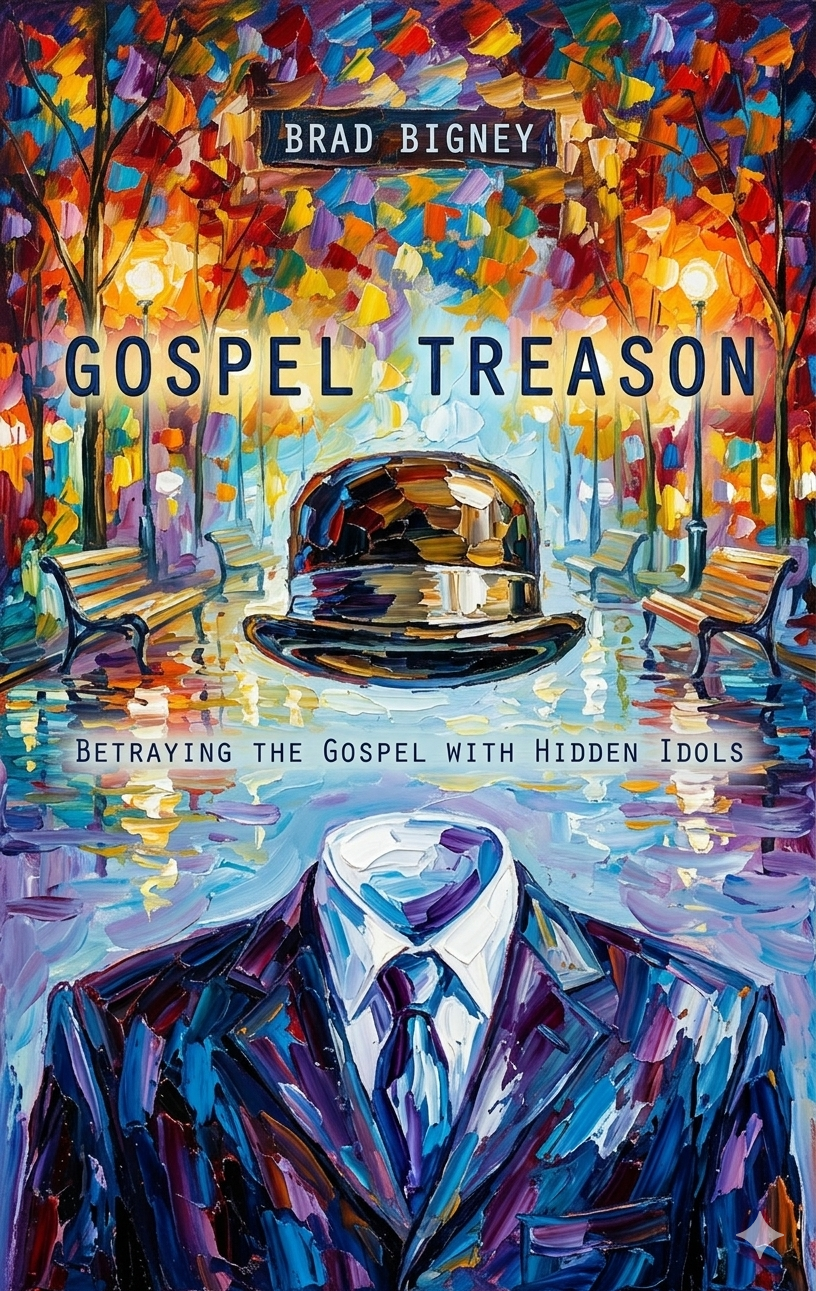
Have you ever wondered if perhaps there is more going on in your life under the surface that you’re just not aware of? Perhaps you recognize your passion is misplaced or that you find yourself unable to understand why you do some of the things you do? The faith group we lead through our church is going through a book called Gospel Treason: Betraying the Gospel with Hidden Idols by Brad Bigney (Amazon affiliate link) and it is such a helpful book! We’re only four chapters into this book, and I’d already HIGHLY recommend this book.
A few reasons why it would be worth picking Gospel Treason up:
- It reveals what’s going on in your heart from a biblical perspective.
- It reveals idols that need to be revealed, torn down, and replaced with true and right worship.
- It walks you through the steps, chapter by chapter to restoring the priorities in your life.
There is a study guide compiled by JD Rogers that is incredibly helpful as well. You can find the study guide here. It’ll download to your downloads folder as a PDF. My review is listed below.

Gospel Treason Review:
The most pervasive sin in Scripture is the one we are least likely to spot in ourselves.
Why This Book Belongs in the Conversation
Most of us are fluent in the language of behavior management. We track habits, optimize routines, run retrospectives on what went wrong, and resolve to do better next sprint. We are far less fluent in the language of worship — and that is exactly the gap Brad Bigney’s Gospel Treason is written to close. His claim is unsettling for people who pride themselves on competence: the recurring conflict, the disproportionate anger, the anxiety that will not quit, the sin pattern that survives every productivity system you throw at it — these are not first of all behavioral problems. They are worship problems. Something other than God has quietly taken the controls.
The diagnosis lands with particular force on capable, disciplined people. An idol, in Bigney’s framing, is rarely a gross vice; it is usually a good thing — marriage, children, security, respect, a clean record of achievement — that has been promoted to an ultimate thing. Professionals who have built a life on competence are perfectly positioned to worship competence and never notice. The book is a field manual for noticing.
It also arrives at a cultural moment that has canonized the worst possible counsel: follow your heart. Bigney spends a full chapter dismantling that slogan from Scripture, which is reason enough for a thoughtful Christian reader to give the book a hearing.
The Author and Position
Brad Bigney is a pastor and an ACBC-certified biblical counselor, writing squarely within the biblical-counseling tradition associated with David Powlison and the “idols of the heart” stream of thought. He leans heavily on Powlison, Richard Keyes, and a Reformed reading of Romans 1, and he writes as a practitioner — most of his examples come from years in the counseling room rather than the seminar hall. The result is theological depth delivered in a plainspoken, pastoral register, occasionally blunt, never academic for its own sake.
The Argument
Bigney’s thesis is that idolatry is not a fringe Old Testament category but the Bible’s most pervasive theme, and that Christians commit “gospel treason” whenever something other than Christ takes functional first place in the heart. The drift is the danger: “To move toward idols is to move away from the gospel and the Savior that the gospel proclaims, so the problem is not peripheral — it is central” (Bigney, ch. 1, “Idols Move In When the Gospel Moves Out”). When the gospel slides off center stage, he argues, the soul’s immune system shuts down and every other disorder rushes in.
His definition is deliberately wide: “An idol is anything or anyone that captures our hearts, minds, and affections more than God” (Bigney, ch. 1). The width is the point. “Even a good thing, when wanted too much, becomes an idol” (Bigney, ch. 1) — which is why respectable people are in the most danger. You can confess Jesus as Lord on Sunday and be ruled Monday morning by your spouse’s approval, the next rung on the ladder, or the image of the perfect family. The confession is orthodox; the functional theology is treason.
From there the book moves from diagnosis to mechanism. Idolatry is an inside job: drawing on Romans 1:21-25, Bigney describes the great exchange by which we trade the glory of God for created substitutes that can never deliver. He then traces how the heart actually drives behavior — stimuli, thinking, emotions, actions, character — insisting that conduct is never as random as it looks. “There is no random sin… You were already thinking something in your heart long before you felt something and acted on it” (Bigney, ch. 9, “Your Heart Is the Processing Center”). Emotions, on this read, are not the disease but the smoke alarm; a disproportionate reaction is an invitation to trace the smoke back to the idol that was threatened.
The cure is not willpower but worship rightly reordered. Bigney closes with three habits: establish a wartime mentality, make choices that starve your idols, and learn to work backward from the chaos in your life to the desires underneath it. Throughout, the refrain is gospel, not technique — glance at the heart, but gaze at Christ.
Where the Book Pushes Hard
The sharpest edge is Bigney’s refusal to let readers treat God as a means to their preferred outcomes. “God is not our Sugar Daddy in the Sky. He’s not some cosmic Santa Claus looking for ways to make us more comfortable. He is looking for ways to make us more like Christ” (Bigney, ch. 1, “Idolatry Is a Lifelong Battle”). The implication is that unanswered prayer is sometimes God declining to subsidize an idol — a claim that will sting anyone who has prayed hard for a good thing wanted too much.
Equally pointed is his frontal assault on the culture’s favorite counsel. Against follow your heart, Bigney sets the Bible’s threefold instruction to guide it, guard it, and refuse to follow it: “Your heart is not your best friend. Jesus Christ, speaking through his Word, is your best friend” (Bigney, ch. 9, “Guide It, Guard It, But Please Don’t Follow It”). And on the permanence of the fight, he is bracing rather than tidy: “The heart is a tireless machine, a twenty-four-hour factory of idols, and as fast as you smash one, your heart cranks out another” (Bigney, ch. 12, “Habit #1: Establish and Maintain a Wartime Mentality”). This is not a book that promises a one-time breakthrough.
Where to Calibrate
The heart-idolatry lens is powerful precisely because it explains so much — which is also its risk. In careless hands the framework can flatten genuinely complex suffering, treating organic depression, trauma, or real injustice as little more than a misbehaving heart waiting to be diagnosed. To his credit, Bigney guards this border himself: he explicitly carves out organic causes, the Puritan “dark night of the soul,” and the legitimate use of medication, and he warns against blasting people who are genuinely afflicted. The calibration, then, is mostly for the reader or would-be counselor who races past those caveats. Read the book with its own guardrails intact, hold the idolatry grid alongside categories of affliction and bodily frailty rather than collapsing everything into it, and keep his closing instruction — glance at the heart, gaze at Christ — from sliding into morbid introspection.
7 Ways to Implement the Book’s Practical Frame
Reading is not the same as obeying. Here are seven concrete ways the argument of this book can become daily practice in the home, the workplace, or the church.
- Run the three questions on a live conflict. After your next real argument, write out Bigney’s diagnostic three: What was I willing to sin to get? What was I afraid of losing? Did I run to it for refuge instead of to God? The answers usually name the idol faster than an hour of introspection.
- Audit your calendar and your bank statement for the actual altar. Bigney says to follow the trail of time, money, and affections. Pull last month’s spending and last week’s hours and add up the totals honestly. Where the time and money pool is where your functional worship lives, whatever your stated priorities claim.
- Treat strong emotion as a smoke alarm, not the fire. The next time anger or anxiety flares out of proportion to the trigger, stop and ask what you believe you must have that is being threatened. The emotion is the indicator light; the idol is the engine fault underneath it.
- Give two or three people permission to name your blind spots. Idols hide best from their owner. Ask a few trusted believers Bigney’s questions directly: “What do you see me running to instead of God? Where do you see a demanding spirit in me?” Then resist the urge to defend the answer.
- Retire “follow your heart” from your vocabulary — and your kids’. Catch the slogan when it surfaces in a show, a song, or your own advice, and replace it out loud with the biblical pattern: guide the heart, guard it, speak truth to it rather than taking orders from it (Proverbs 4:23).
- Obey ahead of feeling in one specific area this week. Pick a single duty you do not feel like doing — a hard conversation, a kept promise, a return to a neglected discipline — and do it anyway. You are field-testing Bigney’s claim that “feelings follow obedience, so you can obey your way into new feelings” (Bigney, ch. 12, “Habit #2: Make Choices That Starve Your Idols”).
- Pair every idol you find with a specific gospel truth. Diagnosis without the cross breeds despair. When you identify an idol, name the gospel reality that dethrones it — the approval idol meets your adoption in Christ; the control idol meets God’s sovereignty and care. Glance at the heart; gaze at the Savior.
Closing Read
Gospel Treason is best read by competent, self-managing Christians who suspect that their real problem is deeper than their habits — and it is most useful to those willing to let it interrogate the good things they have quietly made ultimate. It is not a gentle book, but it is a hopeful one: its whole burden is that the gospel which exposes the idol is also the only power that breaks it. Read with its own guardrails in place, it gives the reader something a productivity system never can — not a better technique, but a reordered worship.
Leave a Reply