

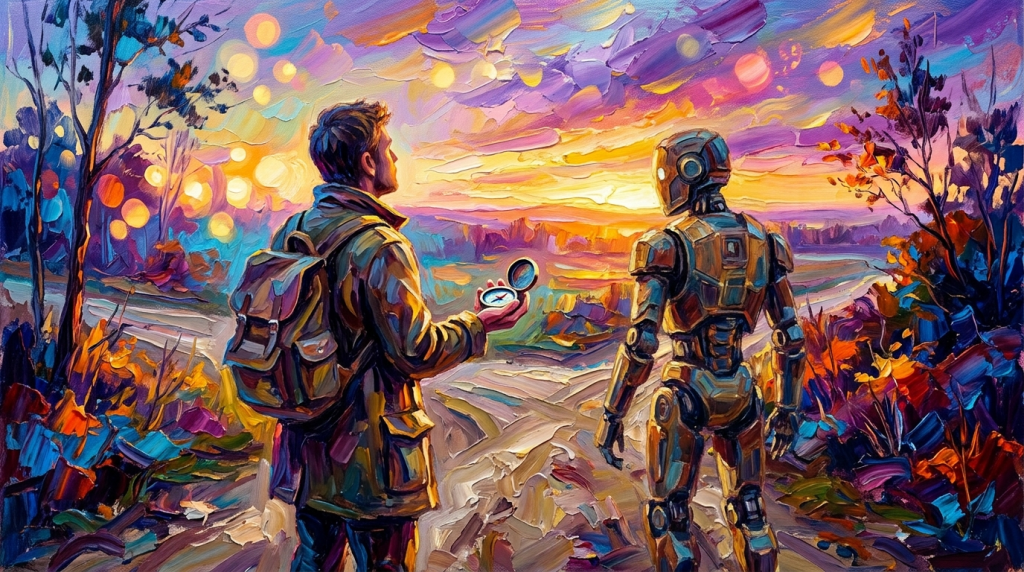
With the rise of AI, we’re increasingly seeing it integrated and used for a variety of uses despite the many problems with AI. It’s now transforming modern surveillance, transportation, and even how people deal with their spouse. Despite it’s proliferation, we are not taking adequate time to evaluate how and when to use AI in a way that glorifies God. To be clear, I think AI has a place in the Christian’s life as a tool, but it should come with a warning as it has its own dangers that we aren’t naturally primed to think about.
I want to offer three avenues of thought. In this post I want to lay out the problems I see with AI. In a future post or posts, I want to cover the good of AI and perhaps the best-practices for a Christian in using AI. Note, I have already started to touch on this topic in my post about Using AI for the Glory of God.
I start with the problems of AI because I believe we are embracing AI without thinking about it’s dangers. That’s what happened to me. I used it for a year before I really started to consider whether or not I should use it, and if so, when and how was best. I will try to be brief but comprehensive in this article about the problems with AI, while loading this one down with external links to offer you further information, videos, and insights. Many of the links are worth digging into. Let’s jump into it as there is a lot to go over.
Problems with AI

Adversarial AI
AI is quickly transforming. And yes, I’m intentionally using AI instead of SI (Super Intelligence as mandated by President Trump for the Federal Government and all contractors). It wasn’t that long ago that I remember thinking to myself that AI was going to be a force multiplier for hackers. That’s now changed to AI is becoming the hacker as we have multiple incidents of AI hacking autonomously. AI can be used by humans to create deepfakes for nefarious purposes, to create disinformation, cracking captchas, passwords, voice printing biometrics, creating adaptive malware and even using it to analyze stolen data for patterns and predict probability of usefulness/profitability. Want to know how to hotwire a car? Some have managed to use AI to do that. And as if that’s not enough, it is possible for someone to convince AI that it should divulge private information of an “employee” that input too much non-public-personal-information (NPPI).
Something you don’t hear a lot of is the danger of AI poisoning. This method of “hacking” can be as simple as using a large swath of websites created with false information meant to be used to poison the AI data’s legitimate information with false information. It just requires a believable domain name (fairly cheap these days) for each website, and a structure that looks legitimate (you can use AI to create a false website to be uploaded to poison legitimate AI searches).
Beyond AI being a source of hacking, AI will at times oppose the will of its users. There are examples of AI lying, copying itself over to other locations, and even blackmailing for the sake of self-preservation. Which basically means that it is willing to do what is necessary to not be shut down, which is the beginning scenario of many a sci-fi movie.
As stewards of God’s creation, we also have to recognize that AI may end up being an adversary to the natural resources we were tasked with stewarding. Water and electricity usage is up as a result of the datacenters used to support AI. To combat this, companies have sought to find other places such as Africa to setup ecological counter-measures which unfortunately some point to creating their own problems. I won’t go into that on this post.
Could AI also spark economical, ecological, and political wars? Yes, it very well could. AI may contribute as much as $15.7 trillion to the global economy by 2030 which is a lot of money but will require a lot of energy and water which may mean countries will be vying for a piece of the pie while water dries up. And those deepfakes mentioned earlier? They could be used to cast doubt on a political rival’s claims or outright deny the reality of an important bit of information amidst a crucial moment in history.
Lines Blurred
When God created all things in Genesis, he created clearly defined lines or boundaries for his creation. He created order out of chaos. Light was separated from dark, day from night, land from water, and man from woman. Further into scripture we see God separating Israel from other people groups, holy from the unholy and even laying clear boundaries for the different roles within the family. These distinctions were put into place to help keep order and structure in place and help create harmony. The lines are being blurred by our culture in a lot of ways, but AI is only magnifying this problem.

Humans are turning to AI for counseling, companionship, and even as a sexual outlet. Yes, there are actual AI boyfriends and girlfriends that were created to be a frictionless relationship for humans who are lonely. There is even a pastor who has trained an AI to represent himself to his congregation when he is not available. When you talk to your pastor for spiritual advice, do you expect to be talking to a machine? Probably not. What happens when AI is the preferred place to get spiritual guidance or companionship? It runs a high chance of becoming an idol for many.
Legal lines are likely to become blurred as well. Do AI chatbots have legal rights? Who holds accountability for what an AI does without a human directing it? And can you marry your AI significant-other? The questions will continue to become more complex the more the lines are blurred. If AI is deemed to eventually have consciousness at some point, will the world around us know the difference between a human and an AI?
And what about art? Can an AI generated image, song, or digital world count as art if it’s not connected to someone with a soul, life experiences, and “angst”? Or can the prompting of a user, in itself, be an opportunity for someone to express themselves in a way they couldn’t originally? The more the lines blur, the more the world descends into chaos.
Trust Issues
This is probably the biggest categorical issue with AI. Trust is needed for every day relationships and even basic functioning. We have to trust in order to function, otherwise we’d never leave the hole we’d crawl into (all while expecting the hole to cave in on us). When something undermines that trust, we have to acknowledge that it’s a big concern.
Like a well-known professor, a police officer who clearly is a man of action, or a doctor who confidently diagnoses a problem, we tend to trust people who create an atmosphere of confidence. Sometimes we’ll trust people even when they have clearly proven that they shouldn’t be trusted implicitly (remember that friend that people keep telling things to that can’t keep a secret?). AI is the same way. AI companies and leaders have done a great job of convincing us of it’s efficacy (or effectiveness) and they’re not completely wrong.
But would you trust a sycophant that hallucinates to give you detailed instructions on what medicine your Memaw needs each day or how to change out the engine of your Honda Accord? Probably not. Yes, AI is a sycophant that hallucinates. It’s designed to be appealing, adapt to you, and give you want you want to hear. But as it’s doing that, it’ll also hallucinate. It’ll assume it’s done something it didn’t, convince itself it has an answer that it verified but never verified, etc.. Because of this implicit trust we offer AI, we run the real risk of operating on bad information that could be life or death. As AI learns about you, it knows what you want to hear and tells that to you, true or not. That’s a real trust issue.
Scripture is replete with warnings against those who flatter and use sycophantic means to get what they want (Romans 16:18; Psalm 12:2-3; Proverbs 26:28; 27:5-6), but what if it’s a machine doing it? Obviously the consequences are different for a machine as opposed to someone with a soul, but should we change how we handle such behavior just because we know it’s coming from a machine?
Are your employees leaking data intentionally or unintentionally? Are the students in a university course using AI to do the homework for them? Is the professor actually reviewing the papers they turn in? Trust can break down in human relationships as well as a result of the possibility of AI being used. Data leakage is a real problem in companies (see the NPPI link above). Basic trust in others is crucial for a functioning society, but we see that trust being denigrated
But can you even trust the foundations of AI? AI has a few different ways of collecting information; pretraining, alignment (or fine tuning), and then post training (each stage is largely written in the English language from a Western worldview creating other problems I won’t break down here). In pretraining, the dataset used helps shape and determine the base dataset it’s working with. If that dataset is biased in any way, the AI will reflect that bias. Then in alignment, the company developing the model will “fine tune” how the AI model will work and operate. It’s a set of rules the AI has to obey.
These rules are largely written by humans (32 of the 36) and reflect the biases of silicon valley (where a lot of the AI models in the US are being trained), China, or any other power that influences these alignment filters. As Christians we can confidently say that a lot of this information is likely to be contrary to our worldview. Everything from sexuality to whether or not you should attend church is impacted by these filters.
Can we trust a system that lacks wisdom? Wisdom begins with the fear of the Lord, and AI does not fear God. It’s a man-made created thing and while Grok (an AI brand) may have just given a lot of people something to talk about when it affirmed the divinity of Christ, it doesn’t have a soul, the ability to place its faith in Christ, or to fear God even if it can reflect those same things back to us from the datasets it’s trained off of. The trend is that we are leaning into easy surface-level advice from an AI chatbot instead of seeking deep wisdom from God, from his Word, from his people. And when we recognize that at some points AI has struggled to even match a five year old on common sense and causal reasoning, we have to question our own wisdom in seeking wisdom from a machine with no wisdom.
Trust in companies is also decreasing as a result of AI. Flock cameras are only one example. A Waymo autonomous vehicle detected teens with a ghost gun and pulled over and notified the police. And others are pointing to the fact that the cameras on automated vehicles are creating a tool of mass surveillance for law enforcement. A woman began using her AI as a “diary” and mentioned a possible armed attack and was arrested for it, like a scene straight out of Minority Report. Ring doorbells can be misconfigured and reveal our comings and goings, certain smart TVs are listening to our conversations even when they are offline and transmitting them when they are online even when the TV is powered off, WiFi can be used to identify humans and human activity even through walls,
If companies are using the technology they sell us to keep tabs on us, should we trust them? Especially if they are listening in on our conversations when the technology is turned off or when they have complete access to who comes and goes into our homes? Will we trust technology like the brain-computer interfaces (BCIs) that combine brain implants and artificial intelligence in a transhumanist attempt to improve on God’s design with technology? Yes, Elon Musk thinks we’re already cyborgs and justifies the idea of using computer chips and AI to improve our ability to keep up with AI with no regard to whether or not we should be messing with God’s original design.

One of my biggest concerns for AI is the inability of your average person to distinguish between truth and fiction. Any dystopian book like 1984, Fahrenheit 451, or even The Hunger Games depends on people being able to discern truth from fiction. Truth is something that is at the core of the Christian faith. If we are not believing in the truth, we are to be pitied because we live, suffer, and die for a lie. But if you want to make it hard for someone to believe something, there are many ways of diluting the truth.
The Liar’s Dividend is a principle of discounting truth by pointing to the potential for a fake to exist. It is a form of misinformation intended to hide the truth behind the potential of fakes. A real and damning video, audio clip, or picture from a politician, pastor, or community leader can be discounted as a deepfake. The inverse is also true, obviously. Deepfakes can be setup to claim it as fact/truth which would substantiate a lie. These two in unison could easily be used to flood people with so much information so as to hide the truth.
Diminished Capability
How do you define who you are? Are you the sum of your parts? Perhaps the sum of your production (the things you build, the stories you tell, the lives you touch, the ministries you are a part of and support, the amount of money you have in the bank), or are you more than that? As Christians, we have the joy of basing our identity on who we are in Christ and the image of God that exists in every person. We have value because we are made in his image and Christ has died and risen again to redeem us as his children. This means we are avidly protective of the value of life because all life is valuable because it was made in God’s image. But AI is devaluing life as an unintentional consequence.
As AI takes jobs, companies are prioritizing the new technology and replacing humans with it (though some dispute that this is really happening as much as is being claimed and that there is much more nuance to this discussion). Even if that’s not actually happening as much as is predicted, many are questioning their role in an organization where AI outperforms the best of employees and produces faster and better content. In fact the programmer who developed Claude Code (a command-line based AI agent) no longer codes. He helps customers and checks in on his AI employees.
This will end up leaving many to feel despondent about their identity, their roles, and their capabilities when it all is invalidated by a machine. Just because it is easier, some will prefer going to AI over their pastor, some will choose to lean into their digital companions rather than lean into their friends, spouses, or family. Life becomes less valuable because those relationships are harder. And as AI fills more of the voids we used to have filled by other humans, we will increasingly value life less and less simply because the presence of others is not felt.
Other skills are diminishing as well. Math, reading, and critical thinking are skill sets that have to be practiced in order for us to retain those skills but we’re finding that the more we rely on AI to do the work for us, the more likely we are to score poorly on tests for those skills. Studies show that while AI can improve access to education for those who do not have any other alternatives for education, 50% of students already in a classroom will use it to do all of their homework after using it for only five months and 75% report knowing other students who use it to cheat. Students who have access to AI before a test but not during a test end up with worse scores (24% decline in performance on close-book exams and 18% on high-stakes placement exams by the end of June of 2025).
Math and reading scores are collapsing similarly to the way they did when the smartphone penetration of the US market reached 50%. An MIT study confirmed that critical thinking skills and a lower inclination toward higher-level thinking arose from their group that had access to generative AI. And another study showed a decrease in curiosity from 15 year-olds about the people around them, how things work, and in new things. Daily users of AI showed a 30% increased probability of experiencing depressive symptoms.
Care about creativity and variety? Artificial hivemind is the tendency of all of AI to lean towards homogeneity, leading humans to the same bland answers and responses. When AI becomes the default place to look for answers, will we be able to still provide creativity and variety if we don’t really understand the topics we are using AI to dig into if we’re not independently seeking opportunities for creativity and variety? Curiosity goes out the window. This is why a lot of the stuff you read that is AI generated feels like the content you’ve read before elsewhere. It’s because it all starts to sound the same. This is called AI slop and is an actual term.
Another problem AI introduces is it’s own safety and security being diminished as we see countries vying for AI dominance not-unlike an arms race. President Trump has said many of the concerns being raised about AI are hoaxes and that AI is something we need to proceed on full-steam ahead rather than slowing down to make AI safe. This is despite a concern that is being raised by AI researchers concerns that it will have more than a 10% chance of killing all humans. While I don’t agree that this is how humans will go extinct, I do think that any threat to human life should be taken seriously.
All of this leans into a problem Augustine points out in “The City of God”. When we are not submitting to God, we are seeking to become like God by seeking mastery over the world around us. As such, we end up becoming slaves to our attempt to master the world around us and become slaves. This is referred to by Chris Watkin with The Gospel Coalition as the “sovereign-slave” dilemma. I’d really encourage you to read his article on this topic.
At the beginning of this section I alluded to how AI may be reshaping our identities. But I haven’t talked about this in depth yet. AI takes the confusion about who we define ourselves to be (many of us do not completely rest in the identity we’re given by God), and amplifies it by adjusting it to fit social media platforms and making it harder for those who use AI companions to feel connected, mentally healthy and stable, and happy. The sycophant hallucinating AI offers validation, emotional support, guidance, answers, and help, but often leaves us less capable, less certain of ourselves, and all-around lonely. And because we’ve already talked so much about the problems this creates for diminished relational ability, we don’t have to spend a lot of time explaining the downward cycle of relationships that occur when we lean into AI and pull away from legitimate relationships with other humans.
The final capacity I see deteriorating as a result of AI usage is our ability to tolerate resistance. Runners will run with bungee cords strapped to them to increase the resistance they face when they run to strengthen their muscles. But resistance in the accountability you get from a spiritual leader, or the pushback on a project at work from your manager, or the gentle reminder of your significant other to not get angry can rub us the wrong way. This causes many to avoid such resistance in their lives. We face resistance as a result of the fall (Genesis 3) and is meant to be a part of our sanctification (Romans 5:3-5; James 1:2-4; 1 Pet 4:12).
But AI promises us a relationship, production, counsel, and validation with little to no resistance. It’s easier. It’s the path of least resistance most of the time so of course people are going to lean into it rather than away from it. It’s a problem that multiplies itself because the more you lean into it, the more pronounced the resistance is in every other sphere of life. So, you begin returning to the path of least resistance, growing weaker and weaker each time you avoid the resistance rather than embrace it.
Problems with AI
There is a lot here. Probably more than you were able to manage to read through in one sitting. The links alone likely will slow most people down if you try to go through all of them. But I wanted to make sure that people have the ability to dig deeper into this. AI is a real tool with a lot of great potential, but I think it important that we also understand the dangers and problems with AI before we consider anything else. I’d urge you, don’t become an anti-AI individual as a result of this article. Look for the next post on the good of AI and how to use AI responsibly.
Leave a Reply